 AIVideoFree
Video to Video AI Generator
Footage in, better footage out: restyle a clip, remove what shouldn't be there with a sentence, or extend past the last frame. Free watermarked preview before any credits move.
Input
MP4 · MOV · WebM, 60 s / 500 MB
Modes
Restyle · edit · extend · re-stage
Models available
4 specialised engines
Output
720p preview · 1080p on credits
Free tier
Watermarked preview, every clip
Typical time
1–4 min per minute
Your uploads
Deleted within 24 hours
Our one-line verdict: the fix-it lane. Re-rolling a generated clip loses everything you liked about it; editing the clip you have keeps all of it and changes the one thing that was wrong.
Video to video is the least-known corner of AI video and often the most useful: instead of generating a new clip and hoping it matches, you keep the footage — its motion, its light, its performances — and change one thing. Four distinct jobs live here: restyling a whole clip, editing objects in or out with a sentence, extending past the final frame without a visible seam, and re-staging a performance into a new setting. Each has a different specialist, which the table below sorts out. Every job gets a free watermarked preview first, because whether an edit holds through motion is something you should see rather than take on faith.
Which model should edit your footage?
Four jobs, four specialists. Each is selectable in the generator above, and every one previews free before you spend.
Kling O3
Point at it in plain language — 'remove the passerby at four seconds, keep everything else' — and it edits the finished clip instead of regenerating it. Also holds multiple referenced characters steady.
Luma Ray 3.2
The Edit variant re-stages footage with frame-level control: subject, setting or style change while the shot's structure and performances survive. HDR and EXR output for grading.
FLUX 3
Seam-aware extension reads the closing frames' motion and audio and continues them — no cut, no reset. Chain a couple and a twenty-second clip becomes forty.
Wan 2.7
A dedicated, mature editing workflow on production-stable capacity: name what changes, name what's protected, get a predictable result on a client deadline.
Video Face Swap
A specialised tool rather than a model: one source photo tracked across every frame, with its own free preview and the consent rules that job requires.
Seedance 2.5
When the brief is a wholesale visual change rather than a targeted fix, regenerating with your clip as reference — and a soundtrack driving the cut — often beats editing.
How to edit a video with AI, in 3 steps
Upload your clip
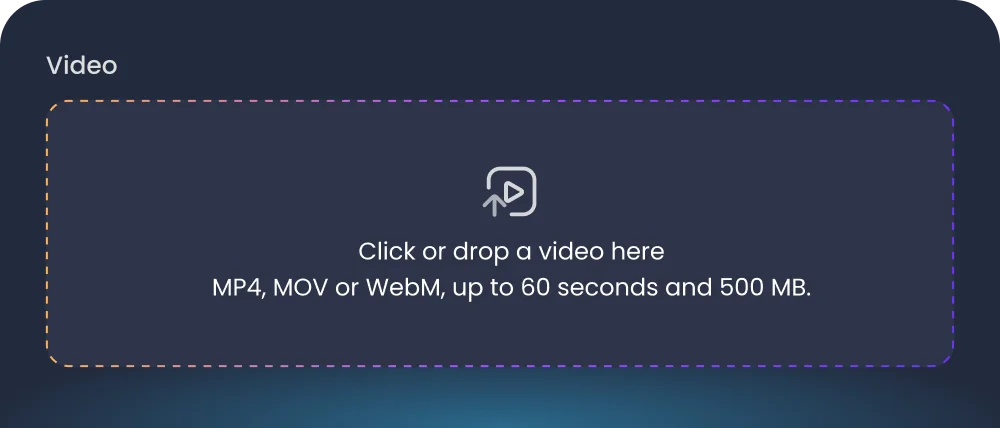
MP4, MOV or WebM up to 60 seconds and 500 MB. Steady footage edits more cleanly than heavy handheld — the tracker has more to hold on to.

Name the change and the protections
Timestamp the target and list what must survive: 'remove the passerby at 0:04 — keep the subject, the camera drift, the lighting and all audio.' The protection clause is what keeps the edit from bleeding into the rest of the frame.

Preview free, then export
The watermarked preview covers the whole clip so you can check the edit holds through the motion. Export at 720p or 1080p on credits when it does.
Where this works — and where it doesn't
The right column is the part most tools leave out. Knowing the failure modes before you upload saves more time than any prompt guide.
Where it works well
• You keep what already worked.
The performance, the light, the camera move — all preserved. Regeneration throws those away and rolls again; editing doesn't.
• Plain-language targeting.
Object removal and replacement are issued as sentences against finished footage, no masks or keyframes required on the conversational models.
• Free preview on every job.
A watermarked pass over the whole clip before credits move, so a failed edit costs you nothing but a few minutes.
• Extension without a seam.
Continuing a clip reads the closing frames' motion and sound rather than starting fresh — the join stays invisible when the instruction describes continuation.
Where it struggles
• Fast motion and occlusion.
Whip pans, heavy handheld and objects passing in front of the target degrade every edit type. Steady footage is worth more here than any setting.
• Sixty seconds per job.
Longer pieces are processed in segments and rejoined in your editor — a compute limit, not a preference.
• Wholesale changes.
If nearly everything must change, editing stops being the cheap path; generate fresh with your clip as a reference instead.
• Deceptive edits.
No removing or adding elements to misrepresent a real event, no unconsented changes to real people, no public figures. Fiction and your own footage: welcome.
What people fix
The unfixable frame
A crew member in shot, a logo you don't have clearance for, a passerby who wandered through the take. Removal with a sentence instead of a rotoscoping afternoon.
Same shoot, several looks
One footage package restyled per campaign variant, keeping the performances that took a day to get right.
Making the clip longer
A generated or shot clip that ends two seconds too early. Seam-aware extension continues the motion and audio rather than cutting to something new.
Questions, answered straight
Any workflow where existing footage is the input: restyling a clip, editing objects in or out, extending past the last frame, or re-staging a performance in a new setting. Unlike text-to-video, you keep the motion, lighting and performances you already have and change only what you name.
Related tools
Start from a still instead of footage.
The specialised face job, with its own consent rules.
Every engine, with one line each on what it wins.